Best Dog Gates for Puppies: Block Off Rooms and Stairs Safely
The best dog gates for puppies: a walk-through gate for doorways, an extra-wide gate for big openings, a freestanding gate for renters, and why the top of the stairs needs a hardware-mounted gate.
A gate is the cheapest way to make a whole house puppy-safe. Instead of watching every doorway, you close off the rooms you can't supervise and let your puppy have the run of the ones you can. It keeps a curious pup out of the kitchen while you cook, off the stairs before it has learned them, and away from the one rug you'd rather not replace.
The right gate depends on the gap you're blocking and whether a fall is on the line. Below are the four we'd fit for a new puppy, from an everyday doorway gate to a hardware-mounted one for the top of the stairs, with the one safety rule that decides which type you actually need.
In this guide
| Type | Best for | Price range | |
|---|---|---|---|
| Walk-Through Pressure Gate | Everyday doorways and halls | $ | Check price → |
| Extra-Wide Gate | Wide openings and archways | $$ | Check price → |
| Freestanding Gate | Odd spaces, no drilling | $$ | Check price → |
| Hardware-Mounted Gate | Top of stairs, real falls | $$ | Check price → |
Our four picks for a new puppy
Most homes need one or two of these, not all four. Match the gate to the gap: a pressure gate for a standard doorway, a wide gate for a big opening, a freestanding one where you can't or won't drill, and a screwed-in gate anywhere a fall is possible.
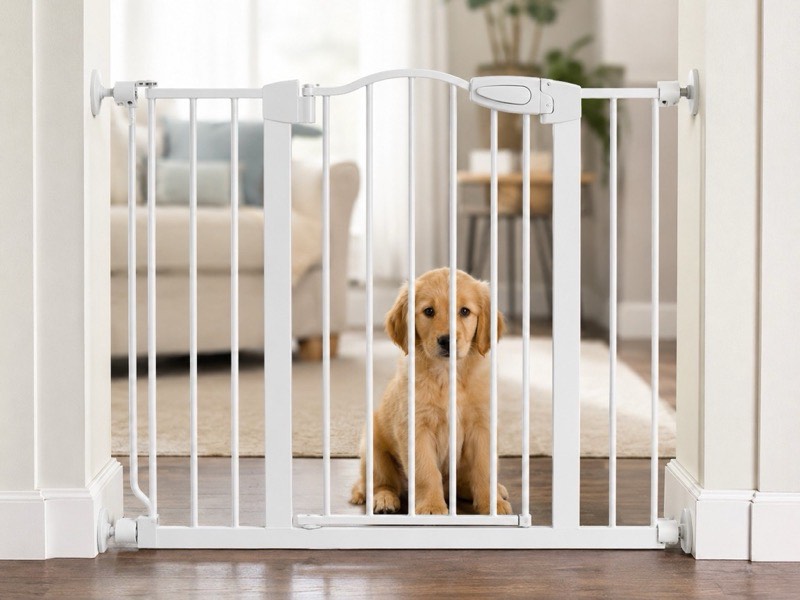
Walk-Through Pressure Gate
Our pick: Cumbor 29.7-46" Auto-Close Walk-Through Gate
A pressure-mounted gate with a hinged door is the one you reach for most. It wedges into a doorway or hallway with no tools, and the door lets you step through without climbing over or dragging it aside every time. Look for a one-hand latch you can work while holding a puppy, and an auto-close hinge so it never gets left open by accident.
Pressure gates are perfect for level ground, like blocking a kitchen or a hallway. Keep them off the top of a staircase, where the same pressure fit that makes them easy to move also makes them easy to push loose.
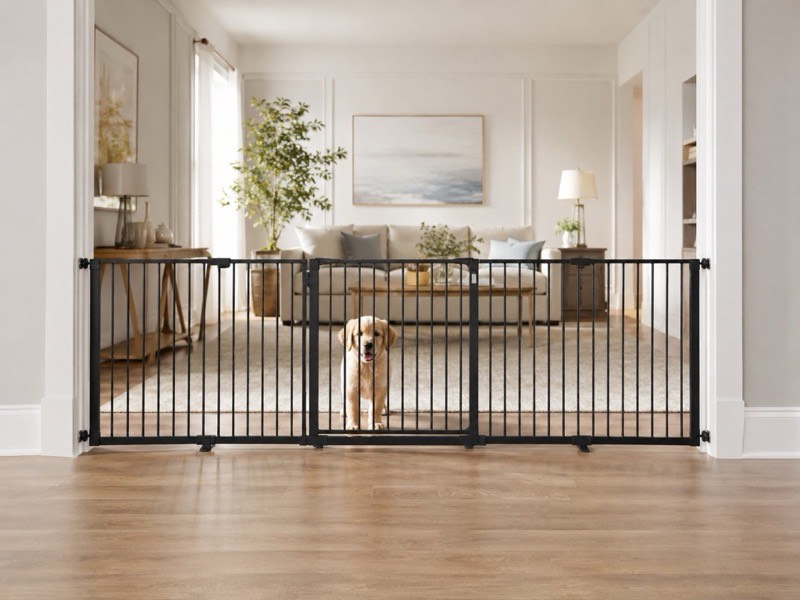
Extra-Wide Gate
Our pick: Regalo 76-Inch Super Wide Walk-Through Gate
Living-room archways and open-plan gaps are often too wide for a standard gate. An extra-wide model spans the opening with add-on panels or a longer frame, so you can close off a space that a normal gate leaves half open. Check the maximum width against your gap before you buy, since the range on the box includes the extensions.
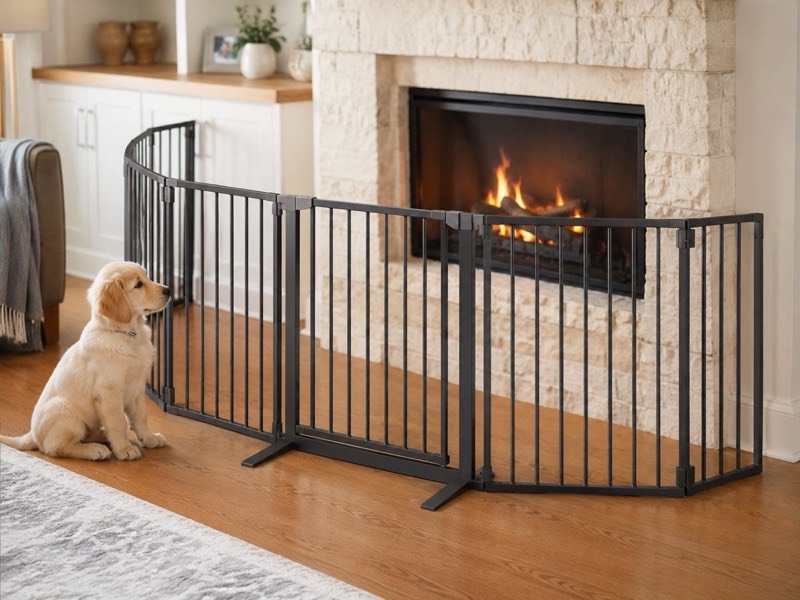
Freestanding Gate
Our pick: Toddleroo by North States Freestanding Pet Gate
When you rent, can't drill, or need to block an irregular spot like a fireplace or a corner, a freestanding gate stands on its own feet and configures into whatever shape the space needs. It moves room to room in seconds and stores flat. It's a barrier, not a fortress, so use it for a puppy you're keeping half an eye on rather than one you're leaving alone all day.
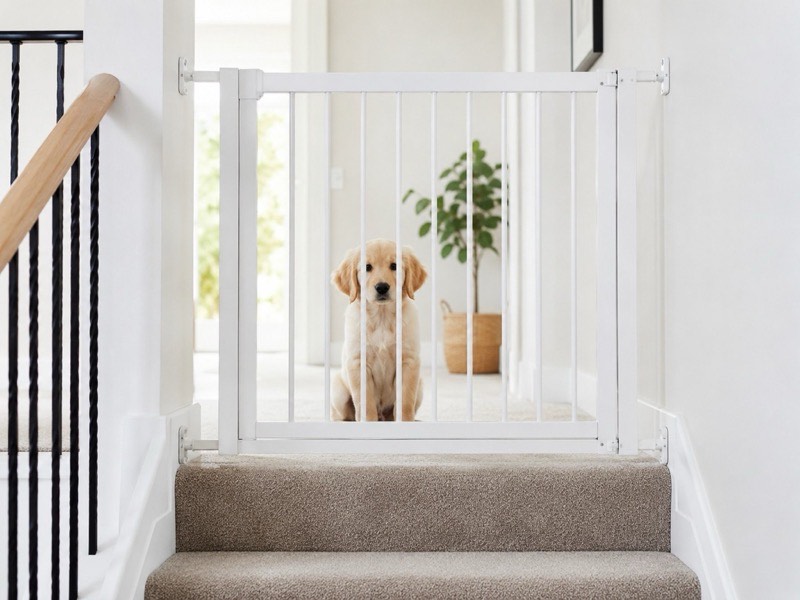
Hardware-Mounted Gate
Our pick: Toddleroo by North States Easy Swing & Lock Gate
At the top of a staircase, a pressure gate is not enough. A hardware-mounted gate screws into the door frame or wall studs so it can't be shoved loose, which is exactly what you want between a young puppy and a flight of stairs. It takes a few minutes and a drill to fit, and it is the one gate worth the extra effort every time.
As an Amazon Associate I earn from qualifying purchases. Product buttons are affiliate links — buying through them may earn us a small commission at no extra cost to you, and never changes what we recommend. Full disclosure.
The one rule for the top of the stairs
This is the safety point that decides everything else: never put a pressure-mounted gate at the top of a staircase. A pressure gate holds by wedging against the frame, and a puppy that leans, paws, or crashes into it can pop it loose and follow it down the stairs. For the top of any stairway, use a hardware-mounted gate that is screwed into the wall or frame, so it stays put no matter what hits it.
A pressure gate is fine at the bottom of the stairs, where a gate coming loose means a nudge across the floor instead of a fall. Some owners gate both ends during the first few months: hardware-mounted up top, a quick pressure gate down below, so the whole staircase is off-limits until the puppy is steady on it.
How to measure and fit a gate
Two numbers keep you from returning a gate: the width of the gap and the height of your puppy.
- Measure the gap at the narrowest point. Run a tape across the opening where the gate will mount, and measure at the height the gate sits, since baseboards and trim can make the bottom narrower than the top. Buy a gate whose range covers your number with room to spare, not one at the very edge of its span.
- Match the height to the dog it will become. A gate a small puppy can't clear today may be an easy hop in a few months. Most standard gates run around 30 inches tall, which suits the majority of puppies, but a tall or bouncy breed is safer with an extra-tall gate from the start.
- Check the bar spacing. On a small-breed puppy, wide bars are something to squeeze through or get a head stuck in. Pick a gate with bars close enough that your puppy can't push between them or wear it like a collar.
Gating is one piece of making the house safe. Pair it with a proper sweep for cords, trash, and anything chewable in the rooms your puppy can reach, which our room-by-room puppy-proofing guide walks through. And when you need a fully enclosed space rather than a blocked doorway, a pen does that job, which the crate vs. playpen comparison and the best playpen roundup both cover.
Shop the full category
See every gate, pen, crate, bed, and mat pick in one place, organized by what it's for.
Questions owners ask
Get the free New-Puppy Checklist
Put the whole first month on one page — supplies, setup, and the routine that keeps training on track.
Get the Free Checklist